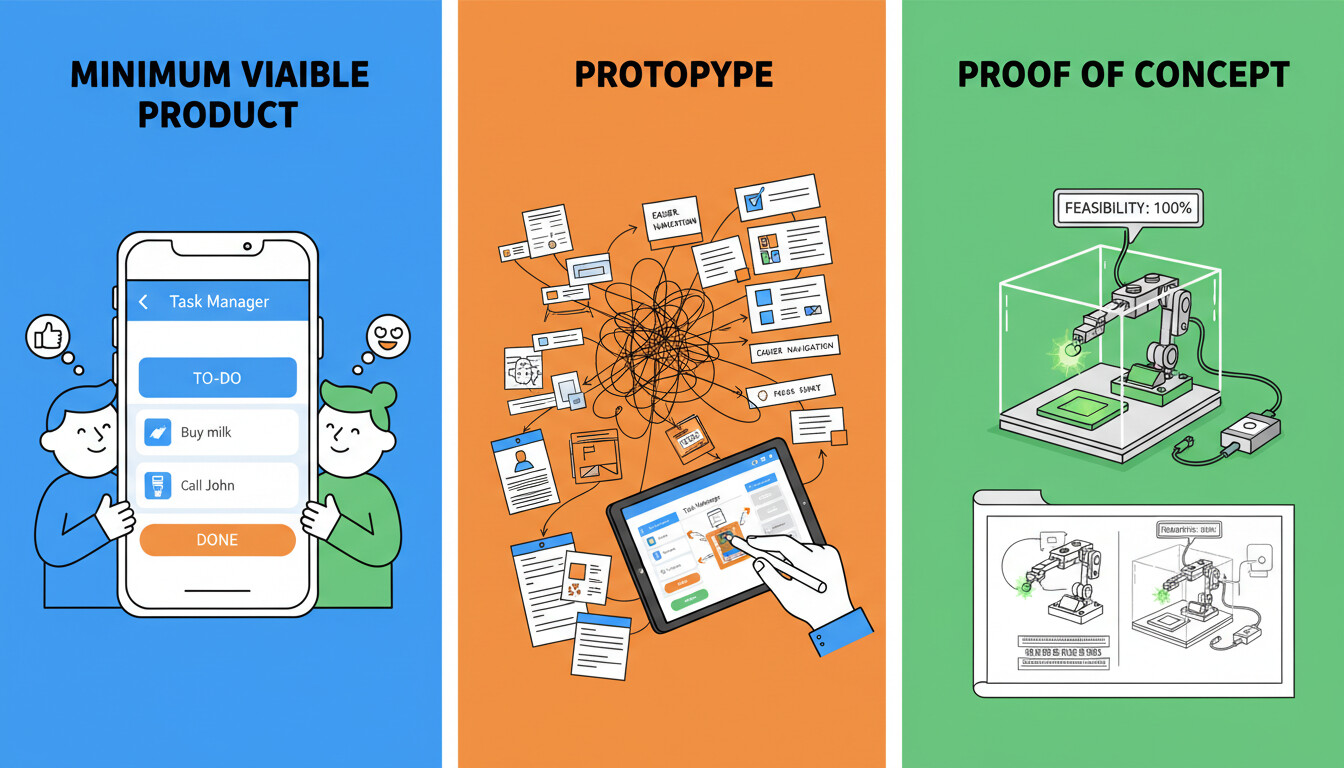
Should you build an MVP? A prototype? A proof of concept? Most founders use these terms interchangeably, and that confusion leads to wasted time, money, and failed products.
These three concepts serve completely different purposes. Using the wrong one at the wrong stage is like bringing a hammer to a job that needs a screwdriver. You’ll make noise, but you won’t make progress.
This guide breaks down exactly what each one is, when to use it, and how to decide which you need right now. By the end, you’ll know which approach fits your situation and how much it should cost.
The Quick Definitions
Before diving deep, here’s the 30-second version:
Proof of Concept (PoC) answers: “Can we build this?”
Prototype answers: “How will this look and feel?”
MVP answers: “Will people use and pay for this?”
Each one validates something different. The right choice depends on what you’re uncertain about.
Proof of Concept: Testing Technical Feasibility
A Proof of Concept tests whether your idea is technically possible. It’s not a product. It’s not even close to a product. It’s an experiment that proves a specific technical assumption.
What a PoC Looks Like
A PoC is minimal and focused. According to TechMagic’s analysis, a PoC usually examines just one feature or integration. If you need to check feasibility of several features, you run several PoCs.
Examples of PoC questions:
- Can our AI model accurately categorize customer support tickets?
- Can we integrate with this legacy banking system?
- Can we process 10,000 transactions per second with this architecture?
- Can we extract data from PDFs with 95%+ accuracy?
Notice these are all technical questions. A PoC doesn’t ask if users want the feature. It asks if you can build it at all.
Who Sees a PoC
PoCs are internal. Your engineering team builds them, your technical experts review them. End users never see a PoC. Investors rarely do either. It’s a behind-the-scenes validation that you can actually deliver what you’re planning.
PoC Cost and Timeline
- Timeline: A few days to 2-3 weeks
- Cost: $1,000 – $10,000 (or just engineering time if in-house)
- Output: A technical report or demo proving feasibility
When You Need a PoC
Build a PoC when:
- Your idea relies on unproven technology
- You’re integrating with systems you’ve never worked with
- Performance requirements are critical and uncertain
- The core innovation is technical, not business model
- Investors or stakeholders need proof before funding development
Skip the PoC when your technology is proven and your uncertainty is about the market, not the tech.
Prototype: Visualizing the User Experience
A prototype shows how your product will look and feel. It’s a visual representation, not a working product. Users can click through it and experience the flow, but there’s no real functionality behind the screens.
What a Prototype Looks Like
Prototypes range from paper sketches to high-fidelity clickable designs. The key characteristic: they lack business logic. There’s no database, no backend, no actual processing. It’s a simulation of the user experience.
Common prototype types:
- Low-fidelity: Paper sketches, whiteboard drawings, basic wireframes
- Medium-fidelity: Clickable wireframes in Figma or Balsamiq
- High-fidelity: Pixel-perfect designs that look like real apps
A high-fidelity prototype might look exactly like a finished app, but clicking “Submit” doesn’t actually submit anything.
Who Sees a Prototype
Prototypes are for stakeholders, potential users, and investors. They help people visualize your vision without the cost of building real software. According to Nomtek’s research, prototypes are excellent for pitching investors, testing usability, and refining UX without building a fully functional app.
Prototype Cost and Timeline
- Timeline: 1-4 weeks depending on fidelity
- Cost: $2,000 – $15,000 for professional design
- Output: Clickable mockups, user flow demonstrations
When You Need a Prototype
Build a prototype when:
- User experience is central to your value proposition
- You need to test usability before coding
- Stakeholders need to “see” the product to approve funding
- You’re comparing multiple UX approaches
- The interaction design is complex and needs validation
Skip the prototype when your product is straightforward and user flows are well-established patterns (login, dashboard, settings). Standard SaaS apps often don’t need extensive prototyping.
MVP: Testing Market Demand
A Minimum Viable Product is real software used by real people. It has just enough features to deliver value and validate whether the market actually wants what you’re building.
What an MVP Looks Like
An MVP is functional. Users can register, perform the core action, and get real value. It’s stripped down, but it works. The “minimum” refers to features, not quality. Core functionality should be reliable.
For a complete guide on building one, see our article on how to create an MVP.
MVP examples:
- Dropbox: Started with just file sync, nothing else
- Instagram: Launched as Burbn with photo sharing only
- Airbnb: A basic website listing the founders’ apartment
- Twitter: Status updates only, no retweets or hashtags
Who Uses an MVP
Real customers use your MVP. Not friends and family being polite. Not beta testers who signed up for free. Actual users who represent your target market, ideally paying for access.
MVP Cost and Timeline
- Timeline: 4-12 weeks depending on complexity
- Cost: $10,000 – $100,000+ depending on scope
- Output: Working software with real users and real data
For detailed cost breakdowns by app type, check out our guide on MVP app development costs.
When You Need an MVP
Build an MVP when:
- Technical feasibility is proven (PoC done or not needed)
- You’re ready to test real market demand
- You need data to guide product decisions
- You want to attract investors with traction, not just ideas
- You’re ready to iterate based on user feedback
Skip the MVP when you haven’t validated that users actually have the problem you’re solving. Don’t build working software to test assumptions you could test with a landing page.
The Comparison Table
Here’s how they stack up:
| Aspect | Proof of Concept | Prototype | MVP |
|---|---|---|---|
| Main Question | Can we build it? | How will it look/feel? | Will people use/pay? |
| Focus | Technical feasibility | Design and UX | Market validation |
| Audience | Internal team, experts | Stakeholders, investors | Real users/customers |
| Functionality | Minimal, specific | Visual, not functional | Core features work |
| Timeline | Days to weeks | 1-4 weeks | 4-12 weeks |
| Cost | $1K – $10K | $2K – $15K | $10K – $100K+ |
| Lifecycle | Discarded after test | Discarded after approval | Evolves into product |
The Right Sequence (And When to Skip Steps)
The traditional sequence is: PoC → Prototype → MVP. Each stage builds on the previous one. But you don’t always need all three.
Full Sequence: PoC → Prototype → MVP
Use the full sequence when:
- Your idea involves unproven technology
- User experience is complex and needs testing
- You have time and budget for thorough validation
- Stakes are high (large investment, regulated industry)
Skip the PoC
Go straight to Prototype or MVP when:
- You’re using proven, well-documented technology
- Similar products already exist (proving the tech works)
- Your innovation is in the business model, not the technology
Most SaaS products don’t need a PoC. The technology for user auth, databases, and web apps is thoroughly proven.
Skip the Prototype
Go straight from PoC (or nothing) to MVP when:
- User flows are standard and well-understood
- Your target users are technical and care more about function than design
- Time-to-market is critical
- You can iterate on design after launch
B2B tools, developer products, and internal applications often skip prototyping.
Skip the MVP (Build Less)
Sometimes you don’t need working software at all:
- Landing page test: Validate demand before building anything
- Concierge MVP: Deliver the service manually to test value
- Wizard of Oz: Fake automation with manual backend work
If you’re uncertain whether anyone wants your product, validate demand first. For strategies on speed, our guide on building an MVP fast without cutting quality covers efficient approaches.
Common Mistakes Founders Make
These errors waste time and money:
Calling Everything an “MVP”
Founders call their prototype an MVP, then wonder why nobody uses it. An MVP has functional features. A clickable Figma file is not an MVP, no matter what you call it.
Building an MVP When You Need a PoC
Spending $50,000 on an MVP only to discover the core technology doesn’t work is expensive. If technical feasibility is uncertain, prove it first with a cheap PoC.
Skipping Validation Entirely
According to CB Insights, 42% of startups fail because they built something the market didn’t want. Often this happens because founders skipped from idea directly to building, without validating anything.
Over-Investing in Prototypes
Spending $20,000 on pixel-perfect prototypes before knowing if the concept resonates is backwards. Start with low-fidelity prototypes. Increase fidelity only when initial feedback is positive.
Treating MVP as “Version 1.0”
An MVP isn’t a complete product. It’s a learning tool. If your MVP has 20 features, it’s probably not minimum. Ruthlessly cut scope to test your core hypothesis.
Decision Framework: Which Do You Need?
Answer these questions to find your path:
Question 1: Is the technology proven?
If NO → Start with a Proof of Concept
If YES → Move to Question 2
Question 2: Is the user experience complex or critical?
If YES → Build a Prototype first
If NO → Move to Question 3
Question 3: Have you validated market demand?
If NO → Run a landing page test or concierge MVP
If YES → Build an MVP
Question 4: What’s your biggest uncertainty?
- “Can we build this?” → PoC
- “Will users understand it?” → Prototype
- “Will users pay for it?” → MVP
Match your approach to your uncertainty. Don’t build working software to answer design questions. Don’t build prototypes to answer technical questions.
Real-World Examples
When a PoC Saved Months of Wasted Work
A fintech startup wanted to build real-time fraud detection using machine learning. Before building anything customer-facing, they ran a 2-week PoC testing whether their algorithm could accurately flag fraudulent transactions using historical data. The PoC revealed 65% accuracy, far below the 95% needed. They pivoted their approach before spending $100K on an MVP that wouldn’t work.
When a Prototype Changed Everything
Trello started as a concept shown to a small group of users. The card-and-board prototype generated feedback that shaped the entire product direction. If they’d built a full MVP first, they might have built the wrong thing.
When Going Straight to MVP Made Sense
Buffer validated demand with a landing page, then built a simple MVP with just the core scheduling feature. The technology was proven (posting to Twitter’s API). The UX was straightforward (pick a time, schedule a post). They didn’t need a PoC or elaborate prototype.
Next Steps Based on Your Stage
If you need a PoC: Define the specific technical question you’re answering. Keep scope minimal. Budget 1-3 weeks and under $10K. The goal is a yes/no answer on feasibility.
If you need a Prototype: Start with low-fidelity wireframes. Test with 5-10 users before increasing fidelity. Focus on the core user flow, not edge cases.
If you need an MVP: Define your core hypothesis. Build only what’s needed to test it. Plan for iteration after launch. Consider a fixed-price MVP service like BuildMVPApp for predictable costs and fast delivery.
Frequently Asked Questions
Can I skip straight to an MVP?
Yes, if your technology is proven and your UX is straightforward. Most SaaS products using standard tech stacks can skip PoC. Products with simple interfaces can often skip prototyping. But don’t skip market validation.
How do I know if my idea needs a PoC?
Ask: “Has anyone built something technically similar before?” If yes, you probably don’t need a PoC. If you’re doing something technically novel (new AI model, unusual integrations, extreme performance requirements), a PoC is worth the small investment.
What’s the difference between a high-fidelity prototype and an MVP?
Functionality. A high-fidelity prototype looks real but does nothing. Click “Buy” and nothing happens. An MVP actually processes the purchase. Prototypes are simulations; MVPs are real products with limited scope.
Should I show my prototype to investors?
Yes, prototypes are great for investor conversations. They help investors visualize your vision without the cost of building real software. But for serious funding rounds, investors want to see an MVP with real users and real data.
Have questions about choosing between PoC, prototype, and MVP? Drop a comment below – we read and respond to every one.